Take part in UK Lunabotics 2027

A year-long engineering challenge for UK university and college students. Design, build and test a lunar construction rover using systems engineering, then compete in our lunar arena. Free to enter, and no previous competition experience needed!

  • Registration deadline: Friday 30 October 2026, 23:59 (UK time)
  • Competition: 6–8 July 2027
  • Location: The Open University, Kents Hill, Milton Keynes, UK

About the challenge

UK Lunabotics is run by The Open University and is based on NASA's Lunabotics Challenge, in which university teams build prototype off-world construction robots. Over the 2026/27 academic year, your team will apply the NASA systems engineering process to design, build and test a rover that can cross challenging lunar terrain and build a berm from regolith simulant. On the Moon, berms like this could protect astronauts, habitats and equipment from the dust and rock blasted out when spacecraft land and take off.

The challenge

Drive your rover, by remote control or autonomously, across a lunar sandbox with obstacles. Collect regolith simulant from an excavation zone and build a berm in a 1.5 m × 0.9 m target area. You operate from a shed using arena camera feeds, without seeing the arena directly.

Who can enter?

Teams of at least two undergraduate or further education students enrolled at UK universities and further/higher education colleges (including degree apprentices), supported by an Academic Supervisor from their institution. Teams from more than one institution are welcome. Entry is free; teams fund their own rover, travel and accommodation.

Why compete?

Gain practical experience of systems, mechanical, electrical and software engineering, from designing frames and mobility systems to writing software for remote and autonomous operations, along with project management and teamwork skills that employers value.

How it is scored

Every rover must first pass a mechanical inspection and a communications check. It is then scored on berm volume normalised for robot mass, berm volume normalised for energy use, bandwidth use (how many arena cameras you choose), and autonomy tasks worth 50–600 points. Each team also gives a short Presentation and Demonstration to the judges. Full scoring is in the rulebook.

Caterpillar, the main sponsor of the US challenge, and NASA's Solar System Exploration Research Virtual Institute (SSERVI) supported bringing the competition to the UK, and the US organisers and Caterpillar UK provide input. UK Lunabotics is not run by NASA, and teams should not describe themselves as affiliated with or sponsored by NASA.

Thinking of Setting Up a Team?

Taking part in the UK Lunabotics competition is a great way to develop system engineering, design, test, communication skills, in a fun and supportive environment.

Discord

Teams from the US Lunabotics competition have set up a Discord for sharing knowledge, and welcome anyone looking to take part in the UK competition to join in the conversation.

Documents for Setting up a Team:

Key Dates for 2027

Registration deadline - email your Statement of Support and Project Management Plan to uklunabotics@open.ac.uk.

Teams notified whether they have a place.

Information day at The Open University, Milton Keynes. Remote connection will be possible, but in-person attendance is encouraged.

Preliminary Design Review (PDR) held by each team.

Critical Design Review (CDR) held by each team.

Down selection to 8 teams.

"Proof of Life" video due, showing your rover moving material and its emergency stop working.

Places at the competition confirmed to teams.

Arrival at The Open University for rover assembly and test.

UK Lunabotics Competition at The Open University, Milton Keynes.

Testimonials

"[Lunabotics] was a great way to amass technical and leadership experience and really helped me to figure out what I liked about engineering on my own time..." Valerie York, 2024 Purdue Lunabotics

Teams

UK Lunabotics ran for the first time in 2026. Seven teams took part in the challenge, and four of them brought their rovers to the competition at The Open University. The winning team has since been invited as the UK entry to the international competition in the USA in late 2026. Thank you to every team, supervisor, judge and partner who made the first year a success!

We look forward to welcoming new and returning teams in 2027. Teams will hear whether they have a place by 20 November 2026 - keep an eye on here!

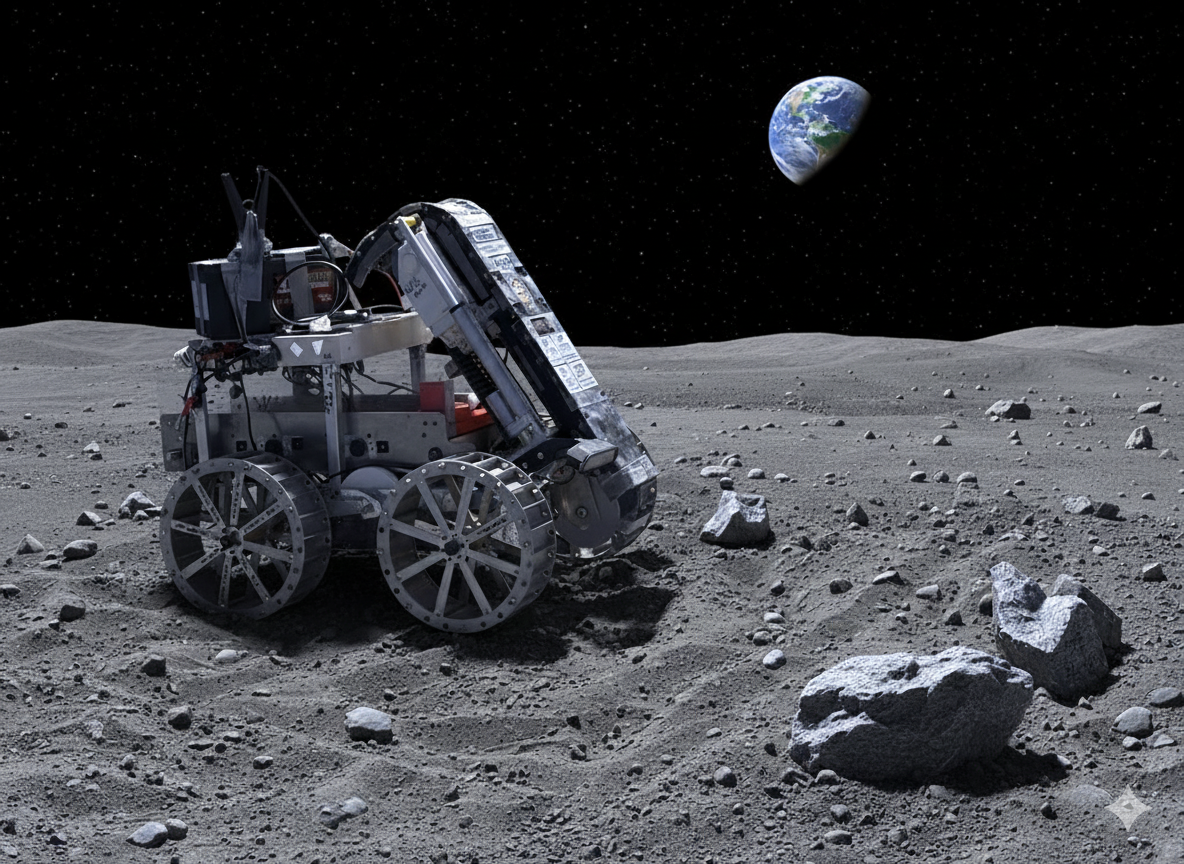
Sample Image

How to apply

By Friday 30 October 2026, 23:59 (UK time), the Academic Supervisor or team lead should email two PDFs to uklunabotics@open.ac.uk:

  • Statement of Support from your Academic Supervisor, on institution letterhead, named SOS-Institution Name.
  • Project Management Plan (max. 5 pages) covering your initial schedule, cost budget, technical objectives and Technical Performance Measures, named PMP-Institution Name.

Use your institution's official name in the file names, not your team name (for example SOS-The Open University). There is no fixed number of places; if we receive more good applications than we have places for, places are offered in order of PMP score. Full requirements and a template Statement of Support are in the 2027 Challenge Overview and Registration Requirements.

Questions? Email us at uklunabotics@open.ac.uk at any stage, including before you apply. No question is too basic.